
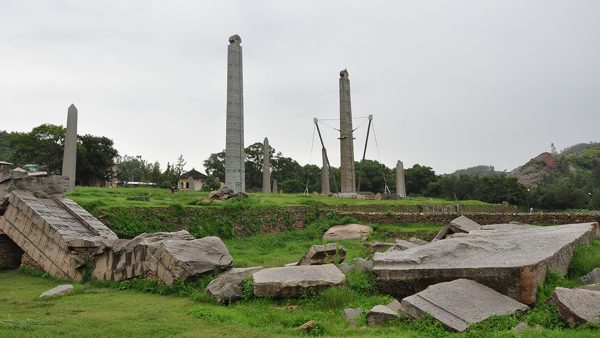
The Stelae Park
Formerly the heart of the Axumite empire that spanned for nearly one thousand years, Axum is home to a 24-metre megalith surrounded by a ring of smaller Obelisks.
Built in the 4th century by King Ezana, the 160 tonne monument had stood in place for over a thousand years, until the colonial aspirations of a nation far from Ethiopia arrived at her borders.
The Italian occupation of Ethiopia is considered by many a period of hardship within the country, with many long hidden artefacts and national treasures being stolen by the occupiers, and despite its mammoth measurements, the Monolith of Axum was taken from Ethiopians in the 1930s.
Found, semi-submerged in a pit by a group of Italian soldiers in 1935, the Obelisk was removed from its home, partially dismantled, and after over two years in limbo, was transported to Rome as a spoil of war.
It was re-erected in Portal Capena square, in front of the Ministry for Italian Relations in Africa, a somewhat ironic end to this stolen spoil of war.
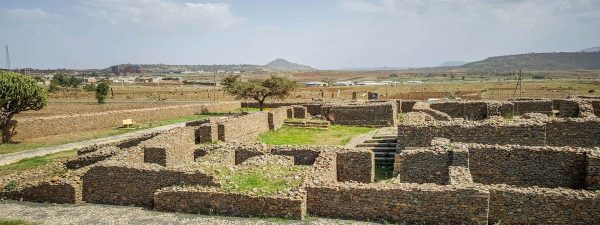
Queen Of Sheba Palace
To a great extent, the early history of Ethiopia was centred around the legends of the Queen of Sheba (Ethiopian) and King Solomon of (Israeli) who had a son who founded the Solomonic Dynasty in and around ancient Axum (Aksum).
The Queen of Sheba who was an “exotic and mysterious woman of power” is one of the great religious figures who appear in the Old Testament, the Hebrew Bible and the Muslim Koran. And her Palace is found right here in Axum. Why would you not want to stop by here and take in the scenery and snap a few photographs?
Okay so now things get a little tricky. The ruins are not the Queen Of Sheba’s Palace as explained to us by our guide but the ruins of Dungur, something a prosperous Aksumite built around 400 to 600 AD. And now the tricky part, our guide explained to us that there is a large possibility that the actual Palace ruins are underneath Dungar as archaeologists have discovered more ruins under these ruins. But also remember that is it local folk law that has been passed down through the generations that this is the site of the Palace of the Queen Of Sheba.
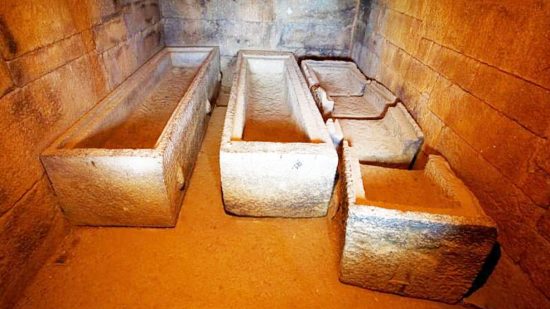
King Ezana’s Park and King Basen’s Tomb
Two of Axum’s more significant historical sites lie within the modern-day town centre, so are an interesting aside if doing some of your own exploration having spent time with a guide in the more well-known areas to the North of the town.
King Ezana’s Park is best-known for a 4th Century stone tablet, inscribed in ancient Greek, Ge’ez and Sabean (the latter two being ancient Ethiopian languages), as well as the remains of what was presumably Ezana’s Palace.
Adjacent to this site is a stele marking the tomb of King Basen which is contrasting to the tombs in the stelae field in that it was carved directly from surrounding rock as opposed to having been block-built. Such differences provide evidence that Axum was an important inhabited site for many hundreds of years, with techniques and fashions of dedicating tombs to Kings changing over this period.